CRM for Logistics and Freight: How to Track Deals When Everything Runs on WhatsApp
Logistics and freight teams run deals on WhatsApp, but no conversation gets captured in a CRM. This guide explains how to fix that without changing how your team works.

CRM for Logistics and Freight: How to Track Deals When Everything Runs on WhatsApp
Most logistics and freight businesses don't have a CRM problem. They have a WhatsApp problem that looks like a CRM problem.
The pipeline exists. The deals are moving. Rates are being negotiated, shipment dates confirmed, and clients are responding. But all of it is happening across a dozen individual WhatsApp numbers, saved as informal chats, managed by whoever picked up the phone first. When a rep leaves, the deal history leaves with them. When a manager asks for a pipeline update, someone opens a spreadsheet and starts guessing.
This is the logistics sales reality. And the tools built for it, generic CRMs designed for SaaS companies or retail teams, tend to ignore it entirely.
Why Logistics Sales Teams Live on WhatsApp And Why That's a Problem
The answer to why logistics runs on WhatsApp is obvious to anyone who has worked in the industry. Clients want instant responses. Shipment windows close fast. A freight buyer comparing three quotes doesn't wait 24 hours for an email reply, they go with whoever responds first. WhatsApp is fast, personal, and works across borders without the friction of email threads or formal correspondence.
In markets across the Middle East, South Asia, Southeast Asia, and Africa, WhatsApp isn't an alternative communication channel. It's the primary one. B2B freight buyers message suppliers on WhatsApp the same way their counterparts in the US might send a Slack message or make a call. This is not going to change.
The problem isn't WhatsApp. The problem is that WhatsApp produces zero structured sales data.
Every conversation stays inside the app it was sent from. A rep quotes a rate to a client on their personal number. The client accepts. A shipment is booked. The CRM has no record of any of it, not the inquiry, not the rate, not the agreed terms, not the booking confirmation. If that rep goes on leave or changes jobs, the relationship context disappears entirely.
For multichannel sales teams, this is a familiar structural problem: the conversation is happening, but nothing is capturing it. The result is a pipeline built on memory, not data.
What Gets Lost When WhatsApp Is Your CRM: Pricing, Terms, Shipment Details
The cost of running sales on WhatsApp without a CRM isn't obvious until something goes wrong.
A client calls to dispute a quoted rate. Nobody can find the original message thread because it was on a rep's personal number. A shipment is delayed and the account manager doesn't know what was promised because the booking conversation happened in a different app. A new rep takes over a client relationship and has no access to 18 months of negotiation history.
These aren't edge cases. In freight and logistics, where contract terms, rates, and exceptions are constantly being negotiated across multiple shipments, the deal record is the conversation. Losing the conversation means losing the deal record.
There are four categories of information that consistently fall through the gap:
- Quoted rates and terms that were agreed informally over WhatsApp but never entered into any system
- Client preferences and constraints (preferred carriers, packaging requirements, delivery windows) mentioned in passing and never recorded
- Shipment-specific instructions shared mid-thread and buried under 200 other messages
- Relationship context (how long this client has been buying, what problems came up previously, what they care about most) that lives only in the rep's memory
The freight broker dealing with a portfolio of 40-50 active clients cannot hold this in their head reliably. Neither can a sales manager trying to forecast which shipment inquiries are likely to convert this month.
The absence of a CRM strategy isn't just an admin inconvenience. It's a direct hit to conversion rates, renewal rates, and the ability to forecast revenue with any confidence.
How a CRM Designed for WhatsApp-Heavy Teams Works
The wrong answer to this problem is telling logistics reps to stop using WhatsApp and switch to email. That approach fails before it starts. Clients aren't switching channels because your CRM doesn't support WhatsApp.
The right answer is a CRM that works where the conversations already happen.
What this looks like in practice: a rep finishes a WhatsApp conversation with a freight buyer. They send a voice note to their CRM via WhatsApp, taking 30 seconds to summarize the call, the quoted rate, and the follow-up timeline. The CRM creates the contact, logs the note, assigns a follow-up task, and updates the deal stage. No web app required. No data entry after the fact.
This is the architecture that actually works for logistics teams. Not a CRM that reps are supposed to update after every call, but one that captures updates from within WhatsApp itself.
Ask Dalil works exactly this way. Reps interact with the CRM through WhatsApp, by text, voice note, or photo, and the system handles the data entry. A rep scanning a business card at a trade event, sending a voice note after a client meeting, or logging a shipment update from the road, all of it goes straight into the CRM without the rep touching a laptop. The system updates and the manager sees it in real time.
For a 15-person logistics team where every rep runs their own client relationships across their own devices, Workflows handle what the rep doesn't have time to: creating follow-up tasks when a quote goes unanswered, moving a deal stage when a shipment is confirmed, and alerting a manager when a high-value inquiry has had no activity in three days.
Murad Metallic Industries faced a similar challenge: 15 reps each operating with individual LinkedIn profiles and phone numbers, with no shared system to capture what was being said or agreed. After unifying the team's communication into a single CRM, they built $250K in monthly pipeline and doubled their customer acquisition rate. The tool didn't change how their team sold. It captured what was already happening.
Tracking the Logistics Deal Pipeline: From Inquiry to Quotation to Shipment
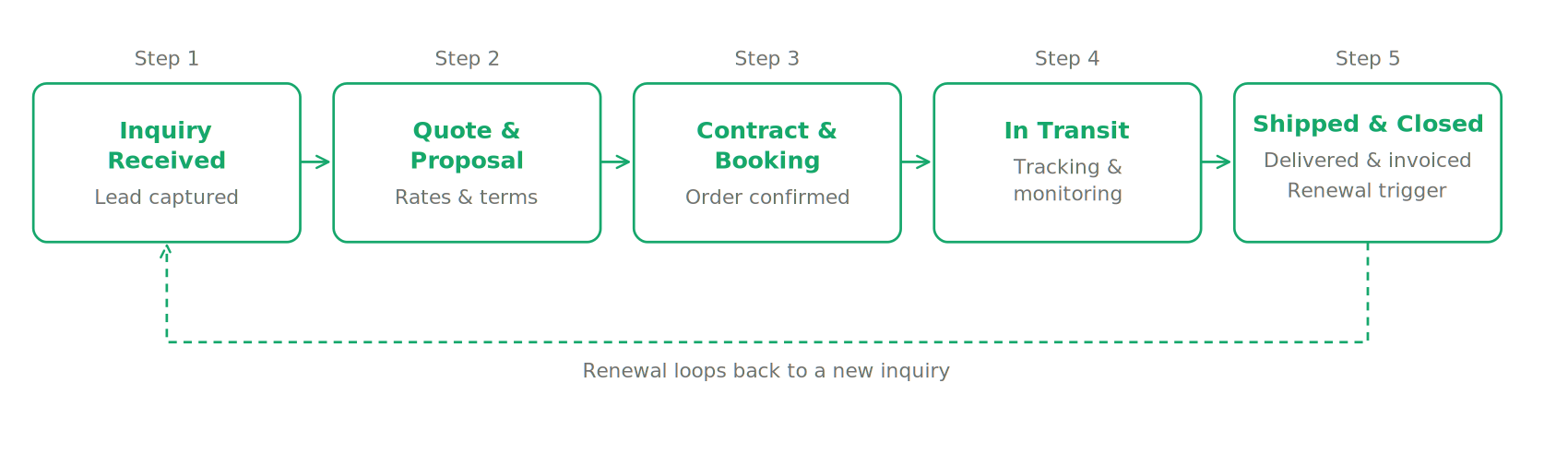
Logistics deal cycles don't map neatly onto SaaS pipeline templates. An inquiry comes in, a rate is quoted, the client compares options, a booking is placed, a shipment is executed, and then, if the relationship is handled well, the client comes back for the next shipment. Managing repeat freight buyers is as much a retention exercise as a sales one.
A logistics pipeline needs stages that reflect how this actually works:
Stage 1: Inquiry Received. The client has contacted the company with a shipment requirement. Origin, destination, cargo type, and approximate timeline are logged. This is the top of the pipeline, volume matters here because not every inquiry converts.
Stage 2: Rate Quoted. A rate has been sent, either via WhatsApp, email, or both. This stage is where most deals stall. The rep needs a clear trigger to follow up, not a mental reminder but an automated task.
Stage 3: Negotiation. The client is comparing options or pushing back on terms. This is where relationship context matters most. A rep who knows this client has used a competitor twice in the last year and came back both times has a different conversation than one who is flying blind.
Stage 4: Booking Confirmed. The client has committed. Documents are being prepared. This is often where a second pipeline kicks in, an operations or delivery pipeline that tracks the shipment through to completion.
Stage 5: Shipped and Closed. The shipment has executed. The deal closes here, but the relationship doesn't. A renewal pipeline starting 30-60 days after close, triggered automatically when the deal reaches this stage, is what separates teams with consistent repeat business from those who re-earn every client from scratch.
The Analytics layer on top of this pipeline is what tells managers which stage is losing deals, how long each stage takes on average, and which rep's pipeline is healthy versus which one is full of deals that haven't moved in three weeks.
What to Look for in a CRM for Freight and Trade Businesses
Most CRM buying guides list features. This one will focus on the three questions that actually determine whether a logistics team will adopt and use a CRM long-term.
Does it work where your reps already work? If the CRM requires reps to switch context, close WhatsApp, open a browser, log into a system, type up what they just discussed, adoption will be low. This is not a discipline problem. It is a design problem. A CRM for logistics teams needs to capture data from WhatsApp, either through native integration or an AI agent that accepts updates via WhatsApp directly.
Does it support multiple pipelines for different deal types? A freight business typically runs new client acquisition alongside repeat shipment management, and often a separate process for partnership or carrier relationships. These cannot share the same pipeline without the data becoming meaningless. Look for a CRM with genuinely separate pipelines, each with their own stages, views, and automation rules. Lead and Deal Management that allows custom pipeline builds per team or deal type is a non-negotiable for a logistics business of any scale.
Does it give managers visibility without requiring reps to report? The whole point of a CRM is that the manager knows the pipeline state without having to ask. If the CRM depends on reps manually updating stages and logging every interaction, the data will always be two steps behind. Look for a CRM that captures conversation context automatically and surfaces it at the deal level. Dalil Brain does this by reading all WhatsApp, email, and LinkedIn threads attached to a record and producing a current deal summary, useful for managers reviewing 30 deals before a pipeline call, and for reps covering a colleague's account on short notice.
For freight forwarding companies with international clients, the ability to run outreach sequences across email and WhatsApp from a single platform also matters, particularly for prospecting new trade lane clients or re-engaging shippers who haven't placed a booking in 90 days. WhatsApp Sequences and Email Sequences that pause automatically when a client replies keep communication responsive without requiring manual intervention.
The broader calculus for a CRM for freight forwarding isn't just feature coverage. It's whether the tool will actually be used. A CRM with 100 features and 20% adoption produces worse outcomes than a simpler system where the whole team is in it every day.
FAQ Section
How do logistics companies track WhatsApp sales conversations? Most logistics companies don't track them at all, conversations stay in individual reps' apps with no structured record. Teams that have solved this either use a CRM with native WhatsApp integration that threads conversations against contact and deal records automatically, or use an AI agent that accepts WhatsApp updates from reps and logs them to the CRM in real time.
What CRM do freight forwarding companies use? There's no single dominant CRM in freight forwarding the way Salesforce owns enterprise SaaS. Many teams use spreadsheets, some use generic CRMs like HubSpot or Pipedrive, and a growing number are switching to platforms that support WhatsApp natively. The right CRM for a freight forwarder is one that captures how the team actually communicates, which in most markets means WhatsApp first.
Can a CRM automatically log WhatsApp conversations about shipments? Yes, but only if the CRM has native WhatsApp integration. This means conversations between reps and clients on WhatsApp appear inside the CRM, threaded to the relevant contact and deal record. Some platforms also allow reps to send updates to the CRM via WhatsApp, logging notes, creating contacts, and updating deal stages through a conversational interface rather than a web form.
What is the best CRM for trade and export businesses? The best CRM for trade and export depends on two things: whether it supports the channels your clients use (typically WhatsApp and email), and whether it can handle multiple pipeline types simultaneously, new client acquisition, active shipment tracking, and renewal management. A CRM that only supports one pipeline or doesn't integrate with WhatsApp will create gaps that offset any benefit from centralizing the data.
How do freight brokers manage their deal pipeline? Most freight brokers manage deals through a combination of WhatsApp, email, and memory, which works at low volume and breaks down as the client portfolio grows. A pipeline with defined stages (inquiry, quote sent, negotiation, confirmed, closed) gives brokers a structure to work from. The key discipline is making sure the CRM captures what's happening in WhatsApp rather than requiring reps to duplicate effort by logging conversations manually after the fact.
More from the blog

Best Outreach Tools in 2026: How to Choose the Right Platform for Your Sales Team
A practical buyer's guide to outreach tools in 2026, covering what to look for, how leading platforms compare, and when to consolidate into a CRM-native outreach system instead.

Multichannel Sales: How to Run Email, LinkedIn, and WhatsApp Outreach from One Place
A practical guide to running email, LinkedIn, and WhatsApp outreach from a single system, covering how the three channels work together and what it takes to measure and manage them without losing context.

Sales Prospecting Tools: The Complete Buyer's Guide for B2B Teams
A practical buyer's guide to sales prospecting tools for B2B teams, covering tool categories, AI capabilities, budget stacks, and how to avoid the trap of over-tooling before fixing your process.