Multichannel Sales: How to Run Email, LinkedIn, and WhatsApp Outreach from One Place
A practical guide to running email, LinkedIn, and WhatsApp outreach from a single system, covering how the three channels work together and what it takes to measure and manage them without losing context.

What Is Multichannel Sales Outreach
Multichannel sales outreach means reaching prospects across more than one communication channel as part of a coordinated sales effort. Not the same message blasted across three platforms. A sequenced, context-aware approach where each channel plays a specific role and the conversation moves forward regardless of where the prospect responds.
The reason it matters is simple: buyers are not sitting in their email inboxes waiting for you. They are on LinkedIn, on WhatsApp, often on both. And they respond in different ways on different platforms. A cold email introducing your company might get ignored. A LinkedIn connection request from the same sender, sent two days later, gets accepted. The prospect then replies to your follow-up message. That exchange gets a response faster than the original email ever would have.
The basic architecture of multichannel sales outreach is a series of coordinated touchpoints across channels, timed to give each one space to breathe, connected to a system that tracks which touchpoints have happened and what the prospect has done in response.
Where teams struggle is not with the concept. It is with the execution. Running outreach across three channels manually is nearly impossible to do consistently. Running it through three separate tools means context gets lost between platforms. A reply on LinkedIn does not automatically pause the email sequence that is still running in the background. A WhatsApp conversation that turns into a warm lead does not automatically update the deal stage in your CRM.
The coordination problem is what separates teams that get results from multichannel sales outreach and teams that just make more noise.
Why Single-Channel Outreach Is Dying
Email was the default channel for B2B outreach for a long time, and it worked because it was novel and inboxes were less cluttered. Neither of those things is true anymore.
The average business professional receives over 100 emails per day. Open rates on cold outreach have declined steadily for years. Deliverability is harder to maintain as spam filters have become more sophisticated. Even well-crafted emails from genuine companies end up in promotions tabs or junk folders with no way to know it happened.
LinkedIn has similar problems at scale. Connection acceptance rates drop when prospects sense automation. Generic messages that could have been written for anyone get ignored at the same rate they always have. The platform has tightened its limits on connection requests and message volume, which caps how aggressively any one rep can pursue volume-based outreach.
None of this means email or LinkedIn are useless. They are not. But leaning entirely on one channel and hoping for volume to solve the conversion problem is a strategy with diminishing returns.
When you add a second or third channel to your outreach sequence, something changes. The touchpoint on LinkedIn confirms that the person who emailed them is real. The WhatsApp follow-up after a LinkedIn conversation feels more personal and immediate. The combination of channels creates the perception of a relationship before one technically exists. That perception matters in B2B sales, where trust is a prerequisite for any serious conversation.
We have seen reply rates increase significantly when a well-timed LinkedIn message follows an email that went unanswered. The email was not failing. It was doing part of the job. The LinkedIn message did the rest. The two together accomplish what neither could alone.
Why Connecting WhatsApp, LinkedIn, and CRM Software Is Still Hard
Every sales rep understands that they should be operating across channels. The tooling has not caught up.
Most CRMs were built for email. Email sits inside the CRM natively. Everything else is an integration, and integrations range from shallow to non-functional. A typical CRM will log sent emails and received replies, create contacts from email signatures, and surface email history on the contact record. That is where the native channel support ends for the vast majority of CRM platforms.
LinkedIn is deliberately difficult to connect to external tools. The platform restricts what third-party software can do with its data, which means most CRM-LinkedIn integrations are limited to a Chrome extension that lets you save a contact and not much else. Two-way sync of LinkedIn messages into a CRM contact record is something that only a small number of platforms handle, and even fewer handle it cleanly.
WhatsApp is harder still. The Meta Business API, which is the official route for integrating WhatsApp with business software, requires business verification, is not available in all markets, restricts message templates, and requires technical setup that most small sales teams cannot handle independently. The result is that most teams use WhatsApp personally and the CRM has no visibility into those conversations at all.
So the typical state of affairs for a B2B sales team looks like this: email is in the CRM, LinkedIn conversations live inside LinkedIn, and WhatsApp is on the rep's personal phone. Three separate places, no shared context, no way to know what the prospect has seen or heard without asking the rep directly.
When a rep leaves, that WhatsApp conversation history goes with them. When a manager tries to review a deal, they get incomplete context at best. When a follow-up needs to happen, nobody knows what channel to use or what was last said.
This is the actual problem that multichannel sales outreach teams face. Not a strategic problem; a plumbing problem. And it does not get easier as the team grows.
Email+LinkedIn+WhatsApp: How the Three Channels Work Together
Think of each channel as having a distinct personality in the sales conversation, and design your sequences around that.
Email is the channel for structured, substantive communication. It gives you space to make a case, provide context, attach materials, and follow up formally. The downside is that it feels formal and requires more effort from the recipient to engage. In a world where attention is scarce, email earns the reply less often than it used to.
LinkedIn is the channel for establishing legitimacy and social context. A connection request tells the prospect you exist as a real person with a professional history they can verify. A LinkedIn message is less formal than an email and sits in a different psychological space: the prospect is already in a professional networking mindset when they open it. LinkedIn works especially well as the second or third touchpoint after email, once the prospect has seen your name at least once.
WhatsApp is the channel for warmth and immediacy. Once a prospect has shared their number or engaged meaningfully elsewhere, a WhatsApp message arrives in a very different place than an email or a LinkedIn notification. Response rates on WhatsApp in active conversations are high, and the conversational format makes back-and-forth feel natural rather than transactional.
The sequence that tends to work looks something like this:
- Email (Day 1): First touch, introduce the problem you solve, clear and specific, no attachments, single CTA.
- LinkedIn (Day 3): Connection request or profile visit if already connected. No sales pitch in the connection note.
- LinkedIn (Day 5-6): Message once connected, referencing the email or something relevant from their profile.
- Email (Day 8): Follow-up with a specific value point or case study, keeps the door open.
- WhatsApp (Day 10-12): If the prospect has engaged anywhere (opened, clicked, replied on another channel), a brief WhatsApp message can restart a conversation that stalled elsewhere.
Treat this as a starting template, not a fixed rule. The right channel order and timing shift with context: in WhatsApp-first markets like the UAE, Brazil, or India, WhatsApp may lead rather than close the sequence; when a prospect shows clear intent, you compress the timing rather than waiting out the full cadence; and for a small set of high-value accounts, a deeply personalized two-channel sequence often beats a five-touch one.
The key mechanism that makes this work is the pause-on-reply logic. If the prospect responds at any point, the rest of the sequence should stop. Nothing kills a warm conversation faster than continuing to send automated touchpoints to someone who has already replied.
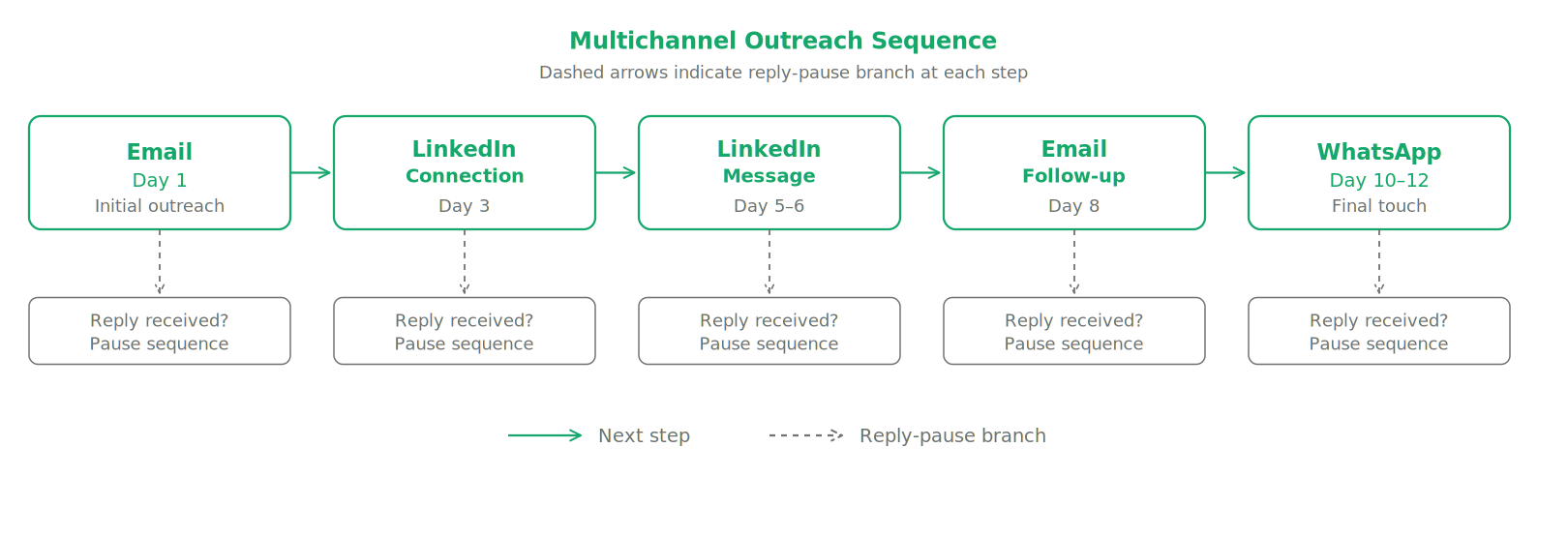
You can see how this kind of sequence is built end-to-end, including the conditional branching based on connection status and reply detection, in this walkthrough:
Unified Inbox: How to Manage Email, WhatsApp, and LinkedIn Conversations in One Place
Once multichannel outreach is running, the management problem begins.
A prospect replies on LinkedIn on Tuesday. The same prospect sends a WhatsApp message Thursday asking for a pricing call. A colleague covers Friday and has no idea a LinkedIn conversation happened. They respond to the WhatsApp message without context, the prospect feels they are dealing with an unorganized team, and the deal cools.
This is not a hypothetical. It happens constantly in teams running outreach across separate tools.
A unified inbox solves this by pulling email, WhatsApp, and LinkedIn messages into a single feed, threaded to the relevant contact and deal record. When any team member opens a contact, they see the full conversation history across every channel; not just emails, not just LinkedIn, everything. Internal notes and task assignments sit in the same view so nothing gets lost in Slack threads or verbal handoffs.
The practical impact on day-to-day sales operations is significant. Handoffs become less error-prone because context is visible without asking the rep who ran the first conversation. Managers can review active deals without scheduling a pipeline review call. Reps covering for a colleague can pick up exactly where the last conversation left off.
For small teams, this is often the feature that makes multichannel outreach sustainable. Without it, managing three channels requires three times the attention, and the cognitive overhead alone is enough to make reps default to the one channel they find easiest to manage.
For larger teams, the unified inbox is a coordination layer. With 20 or 50 reps each running multichannel sequences, the shared visibility into conversations is what prevents prospects from getting double-messaged, missed, or handed off poorly.
The CRM should be the system of record for every conversation. If a message happens in WhatsApp and nobody logs it, that conversation effectively did not happen from the company's perspective.
 Email
Email LinkedIn
 WhatsApp
How to Measure Multichannel Outreach Performance
Most teams measure channel performance wrong. They look at reply rates per channel in isolation and conclude that email is dead or LinkedIn is their best performer, without accounting for the sequencing effect.
A prospect who replies on LinkedIn after receiving an email should not be counted as a LinkedIn win. The email was part of the sequence that created the reply. Attributing the outcome to a single channel misrepresents how multichannel outreach actually works.
The metrics that matter are:
- Sequence-level reply rate: What percentage of prospects enrolled in the full sequence reply at any point across any channel? This is your actual engagement rate.
- First-reply channel distribution: Which channel gets the first reply most often? This tells you where your prospects are most responsive and can inform how you weight channels in your sequence design.
- Step-level completion rate: At which step do most prospects fall out of the sequence? If 60% of prospects never see the LinkedIn message because the sequence is paused after the Day 1 email reply (which means the email is working), that is different from 60% of prospects completing all five steps without responding.
- Sequence-to-meeting rate: What percentage of sequences result in a booked conversation? This is the outcome metric that connects outreach performance to pipeline.
- Channel-specific open and click rates: These are diagnostic metrics, not success metrics. Low email open rates suggest a deliverability or subject line problem. Low LinkedIn connection acceptance suggests your request message or profile needs work.
The reporting mistake to avoid is optimizing for activity metrics. Sent volume, connection requests sent, messages delivered; these are inputs, not outputs. A team that sends 500 messages per week and books 5 meetings is not performing better than a team that sends 200 messages and books 8 meetings.
Good sales analytics should let you drill into the records behind any metric, not just surface-level charts. If your sequence-to-meeting rate drops in a given week, you need to know which step the fallout happened at and which segment of leads it affected. Dashboards that only show totals leave you guessing.
For teams running sequences across email, LinkedIn, and WhatsApp, tracking all of this manually is not realistic. The sequences need to be running inside the same platform that holds the CRM data, so performance metrics and prospect records stay connected. When they live in separate tools, the data can tell you what happened but not why, and not to whom.
FAQ Section
What is multichannel sales outreach? Multichannel sales outreach is the practice of reaching prospects through a coordinated sequence of touchpoints across more than one communication channel; typically email, LinkedIn, and WhatsApp in B2B sales. The channels work together as part of a designed sequence rather than operating independently.
How do you manage conversations across email, LinkedIn, and WhatsApp? The only sustainable way to manage conversations across all three channels is through a platform with a unified inbox that pulls messages from each channel into a single feed, connected to the prospect's CRM record. Without that, you are constantly switching between apps and losing context.
Do I need separate tools for each channel? Historically, yes. Most teams have run a separate sequencing tool for email, a LinkedIn automation tool, and personal WhatsApp with no CRM integration. The better approach, and what a small number of platforms now support, is running all three channels from inside a single system that also holds your CRM data.
What is the reply rate difference between single-channel and multichannel outreach? Exact figures vary by industry, ICP, and message quality, but the directional pattern is consistent: multichannel sequences that coordinate two or three channels typically produce meaningfully higher reply rates than single-channel outreach to the same prospect list. The compounding effect of multiple touchpoints across different contexts; email, professional network, messaging app; is what drives the difference.
How do you avoid messaging the same prospect on multiple channels simultaneously? Through sequence logic with mutual exclusivity built in. When a prospect is enrolled in a multichannel sequence, the system should track which touchpoints have been sent and prevent overlapping messages. If a prospect replies at any step, the sequence pauses across all channels automatically. This requires the channels to be managed within a single system; running them through separate tools makes this coordination nearly impossible to enforce reliably.
Why don't most CRMs integrate with WhatsApp and LinkedIn natively? LinkedIn restricts third-party API access to protect its data and platform experience, which means deep two-way message sync is technically difficult and not universally available. WhatsApp's official business API has verification requirements and template restrictions that limit how it can be used for outbound sales. Most CRMs were built before these channels became sales-critical and have not rebuilt their core architecture to accommodate them.
Can you connect LinkedIn messaging to a CRM? Yes, but the depth of that connection varies significantly by platform. Some tools offer only a Chrome extension that saves contact data without syncing messages. Others support two-way message sync so LinkedIn conversations appear directly on the contact record inside the CRM. The latter is what you need for proper multichannel management; surface-level LinkedIn integration does not solve the context problem.
What is a unified inbox in a CRM? A unified inbox aggregates messages from all connected communication channels; email, WhatsApp, LinkedIn; into a single chronological feed, linked to the relevant contact and deal records in the CRM. Reps and managers see the full conversation history across every channel in one place rather than switching between apps.
Which CRMs have a unified inbox for WhatsApp, LinkedIn, and email? Very few. Most CRMs support email natively and offer partial or shallow integrations for LinkedIn and WhatsApp. Dalil is built with native support for all three channels, with messages from each syncing directly to contact and deal records inside the platform.
How do small teams manage multichannel sales conversations without a dedicated ops person? The honest answer is that without the right tooling, they do not manage it well. They default to whichever channel is easiest for each rep and accept inconsistent coverage across the rest. With a platform that runs sequences across all three channels and surfaces all conversations in a unified view, a small team can operate with the same channel coverage as a larger one, because the system handles the coordination work that would otherwise require dedicated ops support.
More from the blog
Best Outreach Tools in 2026: How to Choose the Right Platform for Your Sales Team
A practical buyer's guide to outreach tools in 2026, covering what to look for, how leading platforms compare, and when to consolidate into a CRM-native outreach system instead.
CRM for Logistics and Freight: How to Track Deals When Everything Runs on WhatsApp
Logistics and freight teams run deals on WhatsApp, but no conversation gets captured in a CRM. This guide explains how to fix that without changing how your team works.
Sales Prospecting Tools: The Complete Buyer's Guide for B2B Teams
A practical buyer's guide to sales prospecting tools for B2B teams, covering tool categories, AI capabilities, budget stacks, and how to avoid the trap of over-tooling before fixing your process.