Sales Prospecting Tools: The Complete Buyer's Guide for B2B Teams
A practical buyer's guide to sales prospecting tools for B2B teams, covering tool categories, AI capabilities, budget stacks, and how to avoid the trap of over-tooling before fixing your process.

What Are Sales Prospecting Tools
Sales prospecting tools are software products that help your team identify potential buyers, gather information about them, and initiate contact. That's the functional definition. The more useful definition is this: they are the part of your sales stack that determines whether your reps start conversations with the right people or waste time chasing the wrong ones.
Most teams underestimate how much the tool choice matters at this stage. A bad CRM is annoying. Bad prospecting infrastructure means your entire pipeline is built on the wrong inputs from the beginning. Everything downstream (your sequences, your calls, your proposals) works against the current.
Prospecting tools sit at the top of the sales process, but they don't operate in isolation. What they feed into matters just as much as what they surface. A tool that finds great leads but can't push them cleanly into your outreach workflow creates friction that kills follow-through. The leads go somewhere, usually a spreadsheet, and then get worked inconsistently or not at all.
Before buying anything, be clear on what problem you're solving. Are you struggling to identify who to target? That's a data problem. Are you struggling to reach those people? That's an outreach problem. Are you struggling to follow up consistently? That's a workflow problem. Most teams have all three, but they're not the same problem and they don't have the same solution. A tool that addresses only one of them will feel useful for about two weeks before the original bottleneck reappears somewhere else in the process.
The best prospecting setups we've seen start with a defined ICP, then choose tools that surface signals matching that ICP, and connect directly to outreach sequences without manual intervention. The tools that require a human to move data between steps (export CSV here, import there, trigger sequence manually) are where deals die quietly.
Categories of Prospecting Tools: Intelligence, Enrichment, Intent
There are three distinct layers in a prospecting tool stack, and most buying decisions go wrong because teams conflate them or assume one tool handles all three.
Sales intelligence tools are searchable databases. They tell you who exists, what their role is, what company they're at, and how to reach them. LinkedIn Sales Navigator, Apollo.io, ZoomInfo, and Cognism fall into this category. The defining characteristic is that you start with zero contacts and leave with a list.
Data enrichment tools take an existing list and complete it. If your sourced contacts are missing LinkedIn URLs, company headcount, direct dials, or verified emails, enrichment fills those gaps. Clay, Lusha, and HubSpot Breeze Intelligence (formerly Clearbit) sit here. A list of 200 fully enriched contacts outperforms a list of 500 with incomplete fields; enrichment is where list quality is determined, not list size.
Intent data tools operate at a layer above firmographics. Where enrichment tells you what a company is (size, industry, tech stack, location), intent data tells you what a company is doing right now. Specifically, whether they're actively researching solutions in your category. Bombora, 6sense, G2 Buyer Intent, and Demandbase monitor content consumption patterns across thousands of B2B sites and flag accounts showing elevated research activity. Intent data is what separates timing from guesswork.This matters because relevance is now a survival metric. A Gartner's 2024 survey of 632 B2B buyers found 73% actively avoid suppliers who send irrelevant outreach (Gartner, June 2025)
There's a fourth layer worth understanding even though it's not a prospecting tool itself: the CRM. A CRM that can't receive prospecting data cleanly, deduplicate on import, and create structured records without manual intervention is a bottleneck for everything the prospecting stack produces. The tools upstream are only as useful as what happens to their output downstream.
How to Build a Prospecting Tool Stack on a Budget
The standard advice here is to list the cheapest options in each category and tell you to start small. That advice is fine but incomplete. The real question is: what's the minimum setup that actually produces a working pipeline, not just a populated spreadsheet?
For teams under 10 reps, here's the sequence that makes sense.
Stage 1: Data source first. Start with one intelligence tool that matches your ICP geography and role coverage. Apollo.io is the most cost-effective starting point for most B2B teams; its free and low-tier plans cover enough volume to test your ICP before committing to higher-cost databases. LinkedIn Sales Navigator is worth it if LinkedIn is your primary channel, which it should be for most B2B sellers. You don't need both on day one.
Stage 2: Enrich before you work the list. Once you have a sourced list, enrich it before outreach begins. A list of 500 prospects with incomplete fields is harder to work than a list of 200 fully enriched ones. Enrichment at the point of import; auto-filling missing LinkedIn URLs, company details, industry tags; is what separates a list you can actually use from one that becomes a manual research project. This step compounds: every hour spent on enrichment now saves multiple hours of dead-end outreach later.
Stage 3: Add intent monitoring when you have volume. Intent data and buying signal tools are worth the investment once you have enough deal history to know what your high-intent buyer looks like behaviorally. Buying those tools before you have that baseline means you're using signals you can't yet interpret. For most teams, this is a growth-stage investment, not a Day 1 priority.
The biggest budget trap is buying tools that overlap without knowing it. Apollo.io does both database sourcing and record enrichment; teams at early stage often add Clay before exhausting what Apollo's enrichment mode already covers within the same subscription. Audit what your existing tools actually do before adding anything new.
Top Prospecting Tools Compared by Category
This isn't a comprehensive software review. It's a practical reference for the tools that come up most often in B2B sales conversations, organized by category with a short assessment of what each one actually does well and where it falls short.
Sales Intelligence Tools
Apollo.io is the default starting point for most B2B teams building their first outbound motion. Large database, built-in sequencing, and a free tier that's genuinely useful. The main limitation is data accuracy in some geographies, particularly outside North America. Worth noting: Apollo has dual functionality of new lead generation and enrichment.
LinkedIn Sales Navigator is the right tool if your buyers are identifiable through LinkedIn, which is the case for the majority of B2B roles. Signal quality is better than any third-party database because LinkedIn's data is self-reported and updated in real time. One important caveat: Sales Navigator gives you searchable access to LinkedIn's database, but it does not surface email addresses or direct dials. Contact-level data requires pairing Sales Navigator with an enrichment tool. Teams that buy Sales Navigator expecting full contact data are regularly surprised by this.
ZoomInfo is enterprise-tier pricing with enterprise-tier data. Strong on US company and contact coverage, compliance infrastructure, and intent data as an add-on. For teams under 50 reps, the price-to-value ratio is difficult to justify unless you're selling into large enterprises where accuracy at senior levels is critical.
Prospeo is a B2B data platform built around verified contact data, and it spans the full prospecting workflow rather than sitting in a single layer. It runs its own searchable database, so you can generate net-new lead lists from filters alone. The practical positioning: a leaner, more accuracy-focused alternative to ZoomInfo for teams that want sourcing, enrichment, and verification in one place without enterprise pricing.
Cognism is the strongest option for European and UK markets where GDPR compliance is critical. Better mobile number coverage than most alternatives in those regions. Pricing is sales-assisted, which means you won't know the cost until you talk to their team.
Data Enrichment Tools
Clay is the most powerful enrichment automation platform available for B2B teams, and also the most frequently misclassified. It runs through various data provider sequentially to complete every record as efficiently as possible. The output is a fully enriched list ready to work. Clay is best suited for teams with a dedicated sales ops or RevOps resource who can build and maintain the workflows.
Dalil handles enrichment as a native step inside the CRM rather than as a separate tool you bolt on. Pull any contact in and Dalil enriches the record automatically: verified email, phone number, and full public LinkedIn data including profile, company, work history, and the last 15 days of posting activity (posts, likes, comments).
Lusha is a contact-level enrichment tool with strong coverage on direct dials and verified business emails, particularly for North American and European markets. It works well as an enrichment layer on top of sourced lists from Sales Navigator or Apollo, filling in the contact data those sourcing tools don't surface directly. Simpler to operate than Clay and more accessible for teams without RevOps support.
Intent Data Tools
Bombora is the category leader for third-party B2B intent data. It monitors content consumption across a co-op network of more than 5,000 B2B websites and tracks surge scores by topic at the company level. If a target account shows elevated research activity around "CRM software" or "sales prospecting tools," Bombora surfaces that signal. For teams with a well-defined ICP and enough target accounts to filter against, Bombora meaningfully improves how lists get prioritized.
6sense goes beyond pure intent monitoring into predictive analytics. It combines third-party intent signals with AI-driven models to predict which accounts are most likely to enter an active buying cycle and which stage of the cycle they're currently in. Enterprise pricing and implementation complexity put this in the category of tools for mature revenue operations rather than early-stage teams.
G2 Buyer Intent captures signals from explicit comparison activity on G2's review platform. A contact actively comparing your product against competitors on G2 is showing higher-conviction intent than someone consuming general category content. The signal is narrower in reach than Bombora but higher in quality for conversion-stage targeting.
Demandbase is an enterprise ABM platform where intent data is one component within a broader account-based marketing suite. Comprehensive but expensive, and best evaluated by teams already running a structured ABM program rather than as a standalone intent data layer.
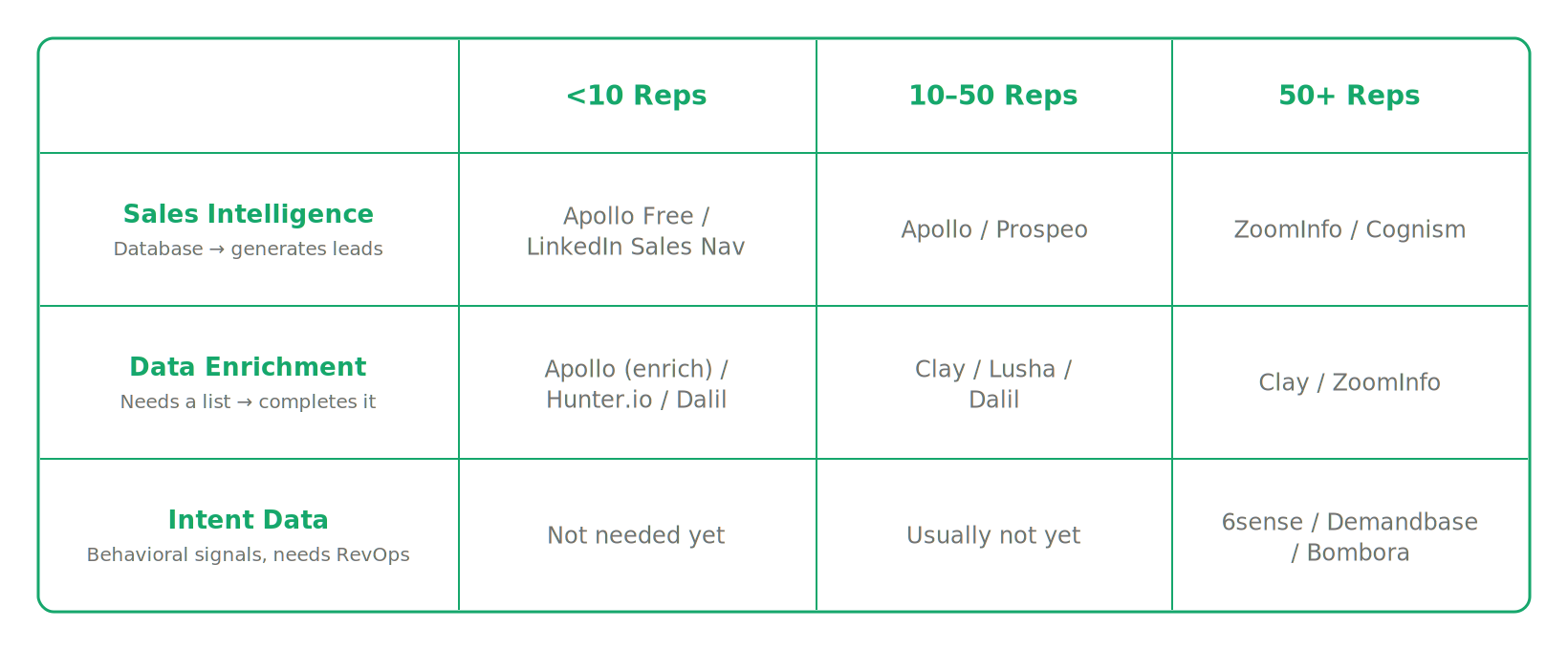
The pattern we see consistently: teams that buy the most sophisticated tools on the market without a clear system to work what they surface don't outperform teams with simpler tools and better follow-up discipline. The tool is a multiplier. If the underlying sales motion is weak, a better tool just scales the weakness faster.
FAQ Section
What are the best sales prospecting tools for B2B companies? The answer depends on where your pipeline bottleneck actually is. For most B2B teams, Apollo.io or LinkedIn Sales Navigator covers intelligence, a tool like Clay or Lusha covers enrichment, and intent data tools like Bombora become worth evaluating once you have deal volume and history to interpret the signals. The best stack is the one with the fewest gaps between those three layers, not the one with the most features.
What is the difference between sales intelligence and lead generation tools? Sales intelligence tools are searchable databases; Apollo, ZoomInfo, Cognism, LinkedIn Sales Navigator. You define ICP criteria and the tool returns a list of matching contacts and companies. You start with zero and leave with a list. Lead generation is a broader term that includes anything creating or capturing demand: ads, content, events, inbound forms. Sales intelligence specifically feeds outbound prospecting; lead generation covers both inbound and outbound demand creation. For teams running a structured outbound motion, the relevant category is sales intelligence.
What are the best prospecting tools for small businesses? Small teams should prioritize tools that don't require dedicated ops to maintain. Apollo.io free or starter tier handles data for most markets. LinkedIn Sales Navigator is worth it if LinkedIn is your primary outreach channel. For enrichment, Apollo's built-in enrichment mode covers most needs at early stage without requiring a separate tool. Intent data tools make sense once you have at least six months of deal data to understand what high-intent behavior looks like for your specific buyer; before that baseline exists, the signals don't have enough context to act on.
More from the blog

Best Outreach Tools in 2026: How to Choose the Right Platform for Your Sales Team
A practical buyer's guide to outreach tools in 2026, covering what to look for, how leading platforms compare, and when to consolidate into a CRM-native outreach system instead.

CRM for Logistics and Freight: How to Track Deals When Everything Runs on WhatsApp
Logistics and freight teams run deals on WhatsApp, but no conversation gets captured in a CRM. This guide explains how to fix that without changing how your team works.

Multichannel Sales: How to Run Email, LinkedIn, and WhatsApp Outreach from One Place
A practical guide to running email, LinkedIn, and WhatsApp outreach from a single system, covering how the three channels work together and what it takes to measure and manage them without losing context.