What Is Prospecting in Sales? A Practical Guide for B2B Teams
A practitioner's guide to sales prospecting for B2B teams, covering definitions, how prospecting differs from lead generation, effective methods, and the best tools to use.
What Is Prospecting in Sales? A Practical Guide for B2B Teams
Prospecting Defined
Sales prospecting is the process of identifying people who might buy from you and initiating contact with them. That's it. Everything else; the research, the sequencing, the follow-up; is in service of that core activity.
A prospect is someone who fits your ideal customer profile but hasn't yet raised their hand. They don't know you yet, or they know of you but haven't expressed intent. Your job in prospecting is to find these people, qualify them well enough to justify the outreach, and start a conversation.
What prospecting is not: it isn't closing, it isn't nurturing, and it isn't handling objections. Those come later. Prospecting is specifically the front end of the sales process; the part where you decide who's worth pursuing and then make first contact.
This matters more than most sales teams acknowledge. Prospecting discipline is the single biggest variable in pipeline health. Teams that prospect poorly tend to compensate with better pitches, better proposals, and more follow-up; none of which solves an empty pipeline.
Prospecting vs Lead Generation: What Is the Difference
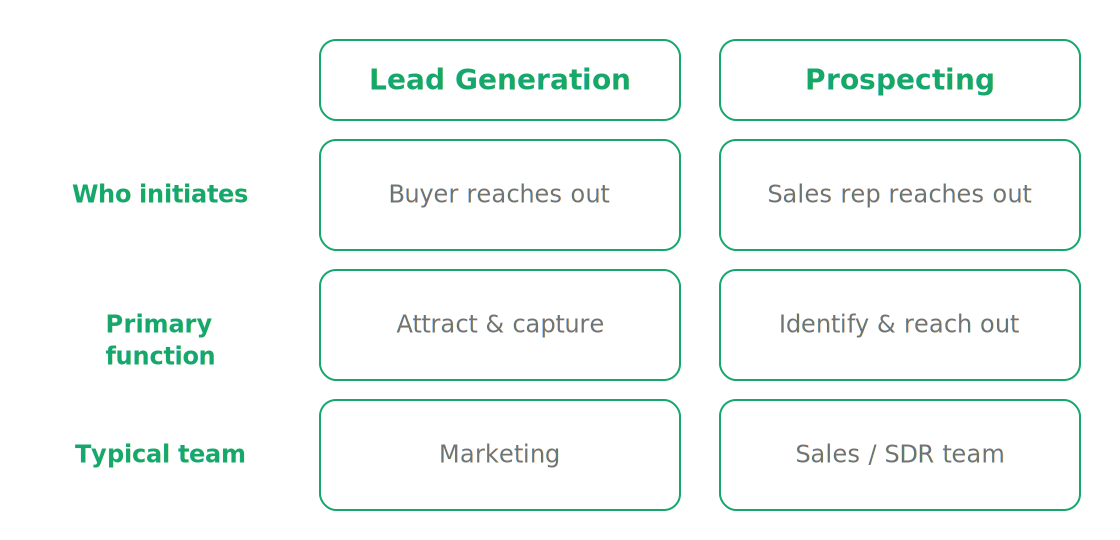
The two terms get used interchangeably, but they describe different activities performed by different people with different tooling.
Lead generation is largely a marketing function. It's the process of attracting people who might be interested in your product through content, ads, events, or SEO. The goal is to get potential buyers to self-identify; to fill in a form, download something, attend a webinar, or raise their hand in some way. The lead comes to you.
Prospecting is a sales function. The salesperson identifies a potential buyer, researches them, and initiates contact. The rep goes to the lead.
In practice, the line blurs. A rep might use marketing-sourced lists as the starting point for prospecting. An inbound lead might require significant qualification before it resembles a real opportunity. But the directional distinction holds: lead generation pulls, prospecting pushes.
For B2B teams without a dedicated marketing function; which is most teams under 20 people; prospecting is where all pipeline starts. There's no content engine feeding a CRM with warm leads. The rep finds the prospect, does the research, makes first contact, and moves them forward.
How to Prospect Effectively in B2B
Effective B2B prospecting is a workflow, not a personality trait. The rep who hits their numbers consistently isn't necessarily more charming or more persistent; they've usually built a repeatable system that removes the daily decision-making about who to contact and how.
Start with a tight ICP definition. "Mid-market SaaS companies" is not an ICP. "Series B SaaS companies in North America, 50-200 employees, with a dedicated sales team and no current CRM" is much closer. The tighter your ICP, the faster your research, the more relevant your outreach, and the less time you waste on deals that were never going to close.
Once you have a clear ICP, sourcing becomes mechanical. LinkedIn Sales Navigator, Apollo, and similar tools let you filter by company size, industry, geography, seniority, and dozens of other signals. The output is a list. The list is the raw material, not the finished product.
Qualification happens before contact, not during it. The best prospectors are ruthless about filtering their list down to people who genuinely fit before sending a single message. A short research step; 5-10 minutes per account; separates mass outreach from targeted prospecting. Look for recent signals: a company that just raised funding, hired a VP of Sales, or launched a new product line is in a different buying posture than one that's been quiet for 18 months.
Then comes the message. Most first messages fail because they're about the sender, not the recipient. They lead with product features, company background, or awards won. The prospect doesn't care. A first message that references something specific to that company; a recent hire, a funding announcement, a content piece they published; gets a fundamentally different response than one that could have been sent to anyone.
Personalization at scale is an architecture problem, not a copywriting problem. If you're manually researching every prospect, you can do maybe 10-15 personalized outreaches per day. If your system enriches leads automatically and feeds you the relevant signal before you write, you can do significantly more without sacrificing quality.
Finally, follow-up is part of prospecting, not a separate activity. Most pipeline stalls in the follow-up gap, not at the pitch. The majority of interested buyers won't respond to a first message; not because they're uninterested, but because they're busy. If your product genuinely helps people and you stop following up because you don't want to be annoying, you're not being respectful. You're walking away from people who would have benefited from what you offer.
The Best Sales Prospecting Tools for Small Teams
Small teams don't need enterprise tooling. They need tools that are fast to set up, easy to use daily, and don't require a dedicated sales ops person to maintain. Here's what actually works at that scale.
LinkedIn Sales Navigator is the default starting point for most B2B prospecting. The search filters are genuinely powerful; company headcount, growth signals, role changes, seniority level, geography; and the lead list export functionality integrates with most CRM and outreach tools. The cost is non-trivial for a small team, but the alternative is spending 3x the time doing the same research manually.
Apollo.io is the most accessible large B2B database for small teams. The search filters cover the usual sourcing criteria; industry, headcount, seniority, geography, tech stack, hiring signals; and a generous free tier means you can build your first lists before paying anything. Data quality is strongest in North America and the UK; coverage gets inconsistent across continental Europe and drops noticeably in APAC and Latin America, so test against your specific ICP before committing.
Prospeo competes on freshness more than coverage. Its B2B leads database covers 300M+ profiles with a 7-day refresh cycle; the industry norm is four to six weeks, which means most competitors are serving stale records by the time you reach them. The 30+ search filters cover the standard firmographic slices plus Bombora intent topics, headcount growth, and funding signals, with strongest coverage in North America and Western Europe. The credit-based pricing favours teams pulling small, frequent, targeted lists over those exporting tens of thousands of rows at a time.
Cognism stands out for European markets specifically. GDPR compliance is built in and the data coverage across the UK, DACH, Benelux, Nordics, and France is meaningfully better than American-first tools. If your ICP is European, this deserves a serious look.
For the CRM and outreach layer, you need something that connects prospecting activity to pipeline; ideally without manual data entry between steps. The prospecting tool should feed the CRM, the CRM should drive the outreach sequence, and the conversation that follows should update the deal record automatically. When those three things are disconnected, context dies between steps and prospects get the wrong follow-up or no follow-up at all.
AI Tools for Sales Prospecting
AI is changing prospecting faster than most other parts of the sales process, and mostly in useful ways.
The most immediate value is in research and enrichment. Tools that automatically pull company details, recent news, LinkedIn activity, and firmographic data into a contact record before the rep touches it are genuinely time-saving. A rep who spends 45 minutes per day on manual research and switches to an enrichment-first workflow can redirect that time into actual conversations.
The second area is signal detection. Modern prospecting tools increasingly surface intent signals; companies that have been researching your category, recently hired roles that indicate buying intent, or funding events that correlate with tool purchases. This lets reps contact accounts at the right moment rather than cold-calling randomly. Timing matters enormously in prospecting. The same message sent to the same person at different points in their buying journey gets very different results.
The third area, and the one getting the most attention right now, is message generation. AI can draft a personalized first message using the prospect's LinkedIn activity, company news, and role context. The output still needs a human edit; AI-drafted messages tend to be grammatically correct but tonally flat; but as a starting draft, they save time and force a structure that reps sometimes skip when writing from scratch.
The catch is that AI outreach has a quality ceiling without a real system behind it. Getting a reply is not the hard part. What happens next is. A prospect replies on LinkedIn, but the CRM doesn't log it. The rep sends a follow-up email as if no reply happened. The lead goes cold not because the product wasn't a fit, but because the workflow broke down between tools. AI accelerates the front end of prospecting; it doesn't fix a fragmented system.
For teams using Dalil, the prospecting-to-pipeline flow works differently. Enrichment runs at the point of import; whether the lead comes from a CSV, a Sales Navigator export, or a LinkedIn list via the Chrome Extension. Once a contact is in the system, LinkedIn Sequences, Email Sequences, and WhatsApp Sequences run from the same platform that holds the deal record. Replies pause the sequence automatically and surface in the unified inbox, connected to the contact record. The rep sees everything in one place and the CRM updates without manual input.
That closed loop; from list to first contact to reply to CRM update; is where most prospecting workflows break. Fixing it is more valuable than optimizing any individual step within it.
FAQ Section
What are the best sales prospecting tools?
For most small B2B teams, a combination of LinkedIn Sales Navigator for list-building, Apollo or Cognism for contact data and enrichment, and a CRM with built-in outreach sequencing covers the full workflow. The exact combination depends on your geographic focus and whether you're prioritizing email, LinkedIn, or WhatsApp as your primary channel. Avoid building a stack where each tool operates independently; the handoffs between tools are where leads and context get lost.
How to use AI tools for sales prospecting?
The most practical applications are enrichment, signal detection, and first-draft message generation. AI enrichment tools auto-fill contact and company records so reps skip manual research. Signal detection tools surface accounts that are actively researching your category or showing buying intent. AI message drafters use that enriched context to generate a personalized first outreach. In each case, the AI handles the preparation work; the rep still owns the conversation.
What is the difference between a prospect and a lead?
A sales lead is anyone who has shown some signal of interest, whether by engaging with content, filling in a form, or appearing on a purchased list. A prospect is a lead that has been qualified against your ICP; someone you've determined is worth pursuing based on fit, timing, or intent signals. All prospects start as leads, but most leads never become prospects. The qualification step in between is what separates targeted prospecting from mass outreach.
How many prospects should a salesperson contact per day?
Honestly, the right number depends on your sales motion, but volume alone is the wrong metric. A rep sending 100 generic messages per day will consistently underperform a rep sending 20 well-researched, personalized ones. A reasonable benchmark for account-based prospecting with genuine personalization is 15-25 new outreaches per day, with additional time allocated to following up on existing sequences. If your system automates enrichment and sequence follow-up, that number can increase without sacrificing quality.
More from the blog
Pipeline Coverage: What It Is, How to Calculate It, and Why It Matters
A practical guide to pipeline coverage for B2B sales teams, covering the formula, stage-by-stage benchmarks, and what to fix when your ratio falls short.
Sales Tracking: What to Track, Which Tools to Use, and How to Set It Up
A practical guide to sales tracking for B2B teams: what metrics actually matter, how to choose the right tools, and how to set up a system that works without a dedicated ops team.
CRM Strategy: What It Is and How to Build One for Your Sales Team
A practitioner's guide to building a CRM strategy that actually sticks, covering what it means, why most fail, and how to build one step by step for your sales team.