How to Build a Sales Pipeline from Scratch
A practical guide to building a B2B sales pipeline from scratch, covering stages, software choices, and the mistakes that quietly kill pipeline health before you notice them.

How to Build a Sales Pipeline from Scratch
What Is a Sales Pipeline?
A sales pipeline is a visual representation of where every active deal sits in your sales process, from first contact to closed won or lost. Each deal occupies a stage, and the pipeline shows you, at a glance, how many deals you have, where they're stuck, and what needs to happen next.
That's the simple version. In practice, a pipeline is also a management tool. It tells you whether you have enough deals to hit your number, which reps are stalled, and where in the process your team consistently loses. A well-built pipeline doesn't just track deals; it generates insight.
The word gets used loosely, which causes confusion. Some people use "pipeline" to mean their contact list. Others mean their CRM. Others mean their revenue forecast. For this guide, the definition is precise: a pipeline is the set of active deals moving through a defined sequence of stages, each with clear entry criteria and exit conditions.
If your current system doesn't have those exit conditions, if deals move from stage to stage based on how a rep feels rather than what has happened, you have a list, not a pipeline.
Sales Pipeline vs Sales Funnel: The Difference
This distinction matters more than most people think, especially when you're building your process from scratch and trying to decide what to measure.
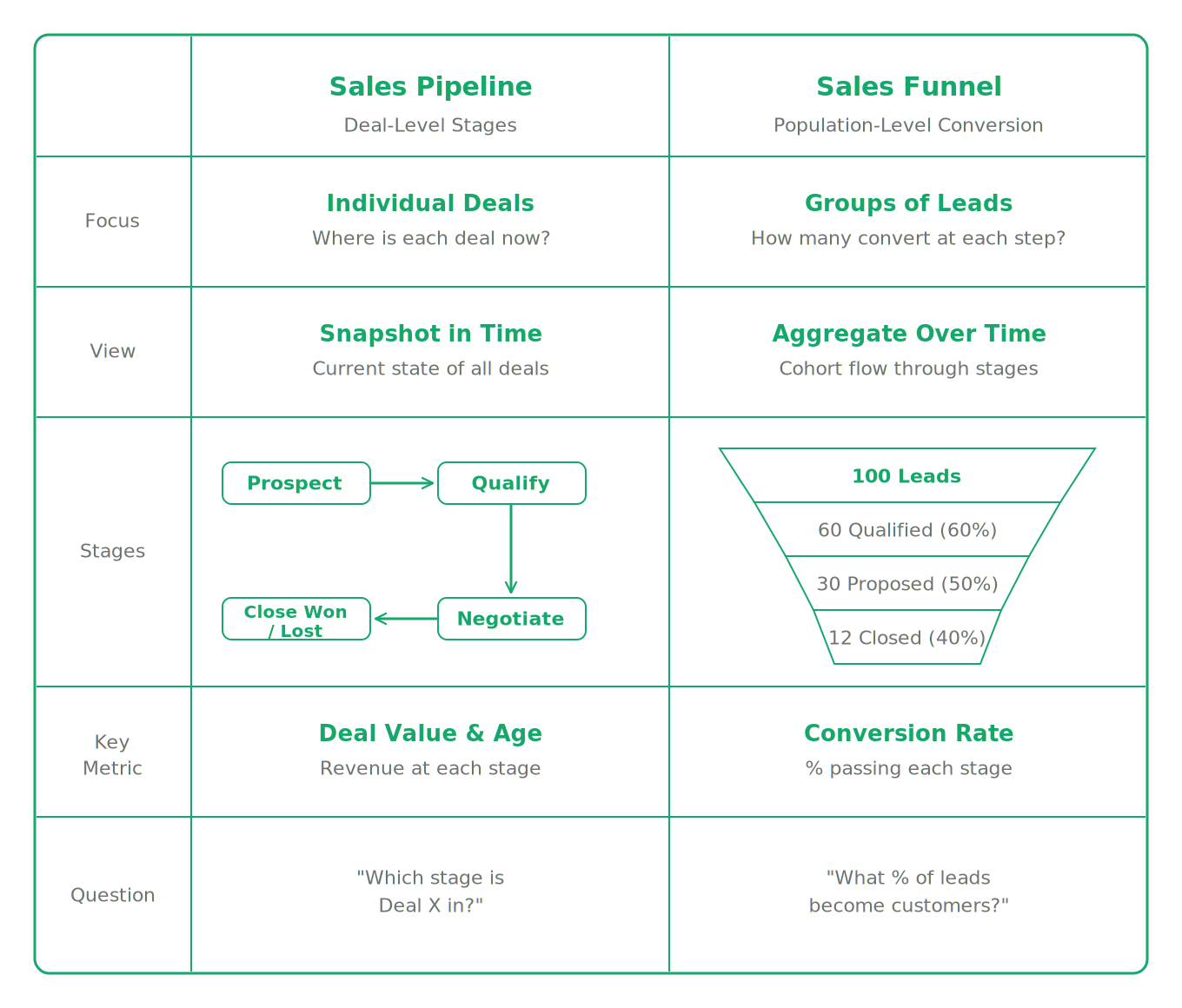
The sales funnel describes volume and conversion across the entire buyer journey, from awareness through to purchase. It's a marketing and analytics concept. When someone says "we need to fix the top of the funnel," they mean the volume of leads entering the system. When they say "our funnel conversion rate is 12%," they mean the percentage of all leads that eventually become customers. The funnel perspective is broad and population-level.
The sales pipeline is deal-level. It tracks individual opportunities as they progress through your defined sales stages. A deal is either in the pipeline or it isn't. You can see exactly which stage it's in, who owns it, and when it last moved.
Here's the practical difference: your funnel tells you that 200 leads this month produced 14 customers. Your pipeline tells you which of those 14 deals are at risk of churning before they close, which rep has 8 deals stuck at proposal for 30 days, and whether your Q3 forecast is realistic.
Both views matter. Founders building their first sales process often obsess over funnel metrics before they've built a pipeline worth measuring. Get the pipeline right first.
Step-by-Step Guide to Building Your First Pipeline
Building a pipeline for the first time is less about software and more about thinking clearly through your actual sales process. Here's how to do it without overcomplicating it.
Stage 1: Map your real sales process, not an idealized one. Write down every meaningful moment that happens between first contact and a signed deal. Don't write what you wish happened; write what actually happens. If prospects always go quiet after you send pricing, that gap is a stage. If there's always a legal review before signature, that's a stage. The goal is to reflect your actual motion, because a pipeline you don't recognize won't get used.
Stage 2: Define 4 to 6 stages with clear entry and exit criteria. Most pipelines work well with five stages: Lead Qualified, Discovery, Proposal, Negotiation, Closed. You can adapt these to your process. What you cannot do is have stages with no defined criteria. "Discovery" means the rep has confirmed the prospect has a real problem, budget exists in some form, and there's a decision maker involved, not just that the rep had an interesting conversation.
Stage 3: Assign an owner to every deal. A deal with no clear owner gets ignored. One person is accountable per deal. In a small team this feels obvious. Once you have five reps it becomes critical.
Stage 4: Set a realistic deal value and expected close date for each opportunity. These two fields are what make your pipeline a forecasting tool. Without them, you have a list of deal names.
Stage 5: Define your pipeline review cadence. Weekly is the standard for most B2B teams. The review should answer three questions: which deals moved forward this week, which deals haven't moved in 14+ days, and what's the total value of deals expected to close this month. Anything more elaborate than that can wait until you have 50+ deals in the system.
Once you've done this on paper, you're ready to put it in a tool.

Choosing Pipeline Management Software
The honest answer is that almost any decent pipeline management tool will work for a team of one to three people. The choice matters more as you scale, when handoffs between reps, visibility for managers, and automation across channels become real problems rather than theoretical ones.
That said, there are real differences worth knowing before you commit to a platform.
The first thing to get right is channel coverage. If your sales happen across email, LinkedIn, and WhatsApp, which is increasingly common in B2B, you need a tool where conversations on those channels automatically surface in the pipeline. If your CRM requires manual logging of every WhatsApp message and LinkedIn reply, your data will be stale within a week. Reps don't manually log things when they're busy. This is not a rep discipline problem. It's a structural problem, and the tool either solves it or it doesn't.
The second thing is how opinionated the tool is about stage structure. Some tools give you rigid templates. Others start blank. Early-stage teams often benefit from a bit of structure out of the box. Having sensible default stages speeds up setup without limiting you later. As your process matures, you want the flexibility to add custom stages, fields, and exit criteria that match exactly how your team sells.
The third is automation. A pipeline that just tracks deals is passive. The more valuable version triggers things: when a deal moves to Proposal, a task gets created to draft the contract; when a deal sits at Discovery for 21 days without activity, the rep gets a notification; when a deal closes, the customer automatically gets enrolled in an onboarding sequence. Workflows like these are the difference between a pipeline that reports what happened and one that helps deals move forward.
For early-stage teams building their first sales motion, the priority is getting something live quickly. Connect your email, import your contacts, build your stages, and start tracking. You can refine from there. The GTM Foundation use case is worth reading if you're at that stage; it describes exactly what a first-week setup looks like in practice.
For teams scaling past ten reps, the priorities shift toward manager visibility, shared conversation history, and forecast accuracy. At that point, tool selection becomes a more serious decision.
Common Pipeline Mistakes and How to Avoid Them
Most pipeline failures are not caused by choosing the wrong software. They're caused by behavioral and structural problems that software alone can't fix. These are the ones we see most often.
Too many stages. A nine-stage pipeline with overlapping definitions is harder to use than a five-stage one with clear criteria. Reps default to the first few stages they understand and ignore the rest. If you can't explain what specifically changes when a deal moves from one stage to the next, merge those stages.
Stages based on rep activity rather than prospect behavior. "Emailed" and "Followed up" are not pipeline stages. A stage should reflect something meaningful about where the buyer is in their decision process, not what the rep did. The difference matters because deals can sit at "Emailed" forever with no indication of whether the prospect is interested, dead, or just slow.
No exit criteria. This is the most common structural flaw. If a rep can move a deal from Discovery to Proposal without having confirmed budget or decision-maker access, your pipeline data means nothing. Deals accumulate in later stages not because they're progressing but because moving them forward feels optimistic. The fix is simple but requires discipline: define what must be true before a deal can move, and review those criteria weekly.
Treating stalled deals as live pipeline. A deal that hasn't moved in 30 days is either at risk or dead. Letting it sit in your pipeline inflates your forecast and gives you a false sense of security. A clean pipeline that shows you $200K in genuine opportunities is more useful than a cluttered one showing $800K where half the deals have been "in negotiation" since January.
Roughly 90% of teams we've seen have no consistent process for aging out stale deals. The ones that do are almost always better at forecasting than the ones that don't, not because their pipeline is bigger, but because they know what's real.
The deeper issue underneath most of these mistakes is adoption. The pipeline only reflects reality if reps are actually updating it. If the tool is cumbersome, if logging a note requires switching apps and filling out six fields, reps will stop. The best pipeline structure in the world is worthless if the data going in is two weeks old. This is why the update mechanism matters as much as the stage structure. Tools that let reps update deals from wherever they already are, from their phone, from WhatsApp, from a voice note after a meeting, consistently outperform those that require reps to come back to a desktop CRM at the end of the day.
FAQ Section
What is the difference between a sales pipeline and a sales funnel? A sales pipeline tracks individual deals through defined stages in your sales process. A sales funnel measures aggregate conversion rates across your entire buyer journey, from lead through to customer. The pipeline is operational and deal-specific. The funnel is analytical and population-level. You need both, but build the pipeline first.
How many stages should a sales pipeline have? Four to six stages works well for most B2B teams. Below four, you lose the ability to spot where deals stall. Above seven, stages start overlapping and reps stop using them consistently. Start with five, run it for a quarter, and add or merge stages based on where your deals actually get stuck.
What sales pipeline stages should I use? A standard starting point: Lead Qualified, Discovery, Proposal, Negotiation, Closed Won / Closed Lost. Adapt the names to your process, but keep the logic: each stage should reflect a meaningful shift in the buyer's position, not just a rep action. If your deals always include a legal review or a technical evaluation, those warrant their own stage.
Can I manage a pipeline without a CRM? You can manage a small pipeline in a spreadsheet, and some early-stage teams do. The ceiling is low: around 20 to 30 active deals, one rep, and a process that doesn't rely on automation or shared visibility. Once you add a second rep, have deals with overlapping stakeholders, or need to track conversations across channels, the spreadsheet breaks. The time you spend maintaining it manually exceeds any cost savings.
What is a healthy pipeline conversion rate? This varies significantly by industry, deal size, and whether you're tracking inbound or outbound leads. A common benchmark for B2B outbound is 1 to 3% of initial prospects converting to closed won. Inbound tends to run higher, often 10 to 20% from qualified lead to close. The more useful question is whether your conversion rate is improving quarter over quarter, and at which stage you're losing the most deals.
More from the blog
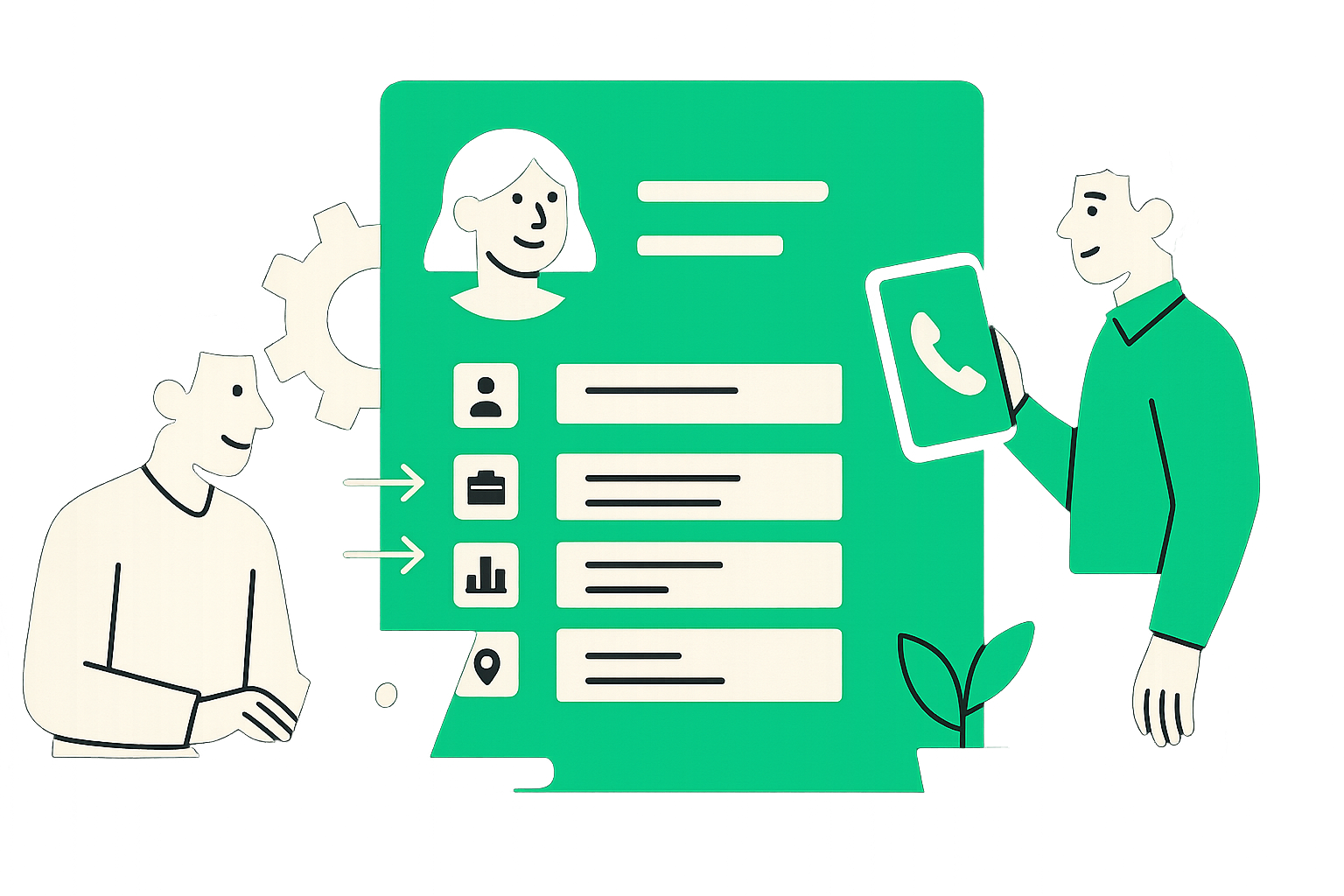
Lead Enrichment: What It Is and How It Improves Your Sales Data
Lead enrichment fills the gaps in your contact records automatically, and understanding how it works can be the difference between a pipeline that moves and one that stalls.
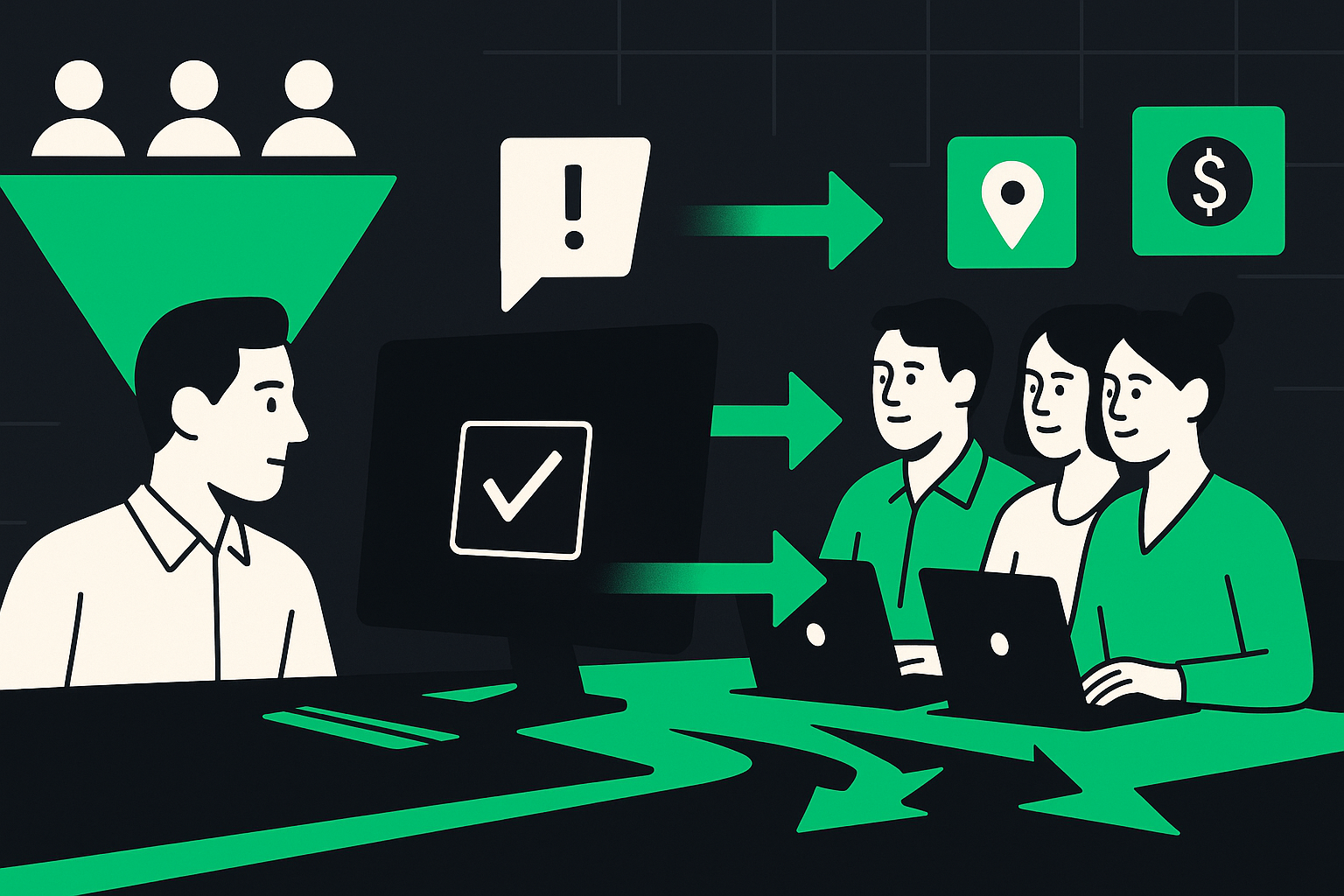
Lead Routing: How to Assign Leads to the Right Rep Every Time
Lead routing determines which rep gets which lead and when; here is how to set up a system that improves speed, fit, and conversion without overcomplicating it.

What Is Prospecting in Sales? A Practical Guide for B2B Teams
A practitioner's guide to sales prospecting for B2B teams, covering definitions, how prospecting differs from lead generation, effective methods, and the best tools to use.